The Happy Note
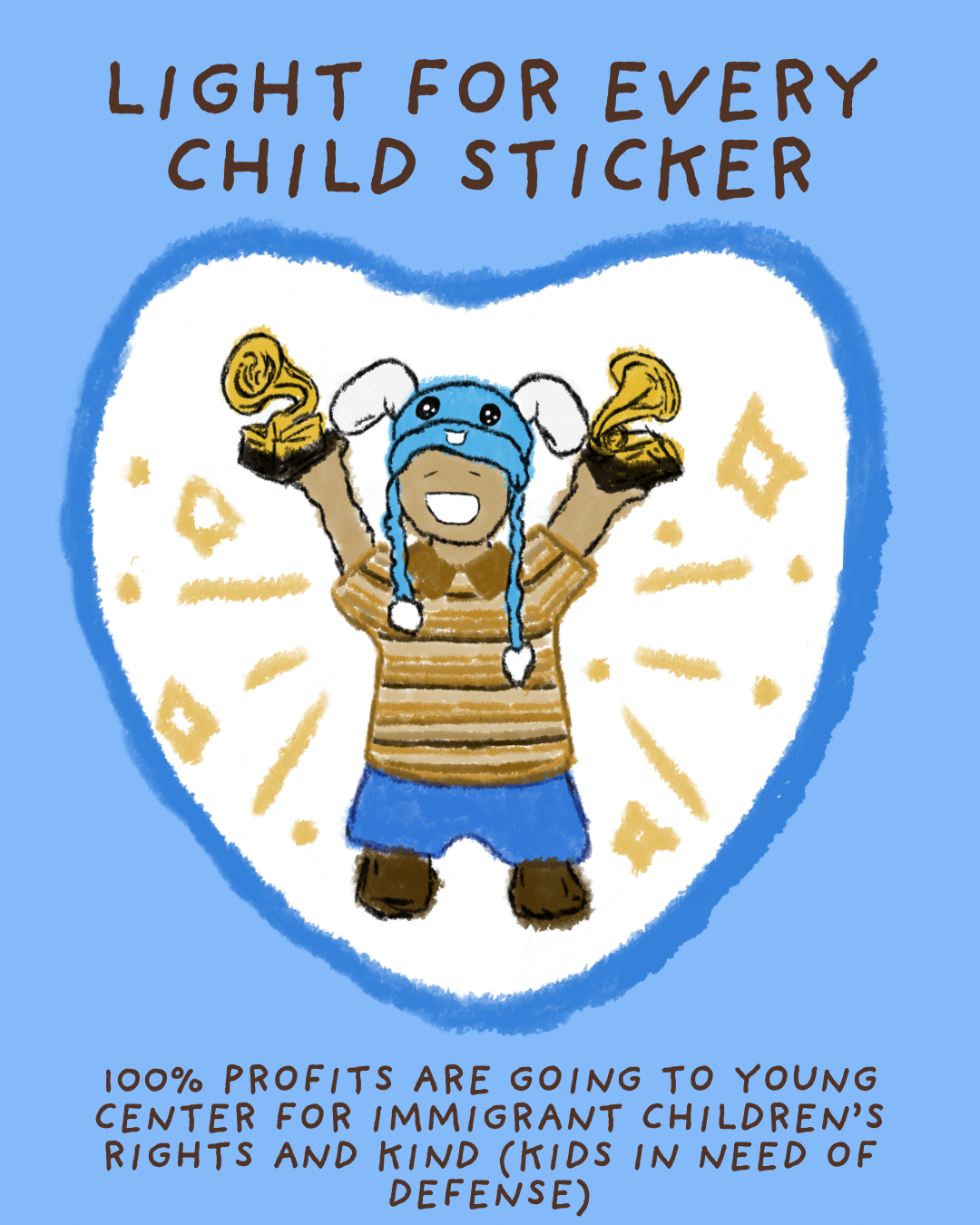
Light for Every Child Sticker
Light for Every Child Sticker
Couldn't load pickup availability
Sticker material: All stickers are laminated and water resistant.
It is with a very open heart that I’m sharing an art piece (sticker) titled “Light for Every Child” for which 100% of the profits will be donated to two organizations that advocate for children detained in immigration centers: Kids in Need of Defense (KIND) and Young Center for Immigrant Children’s Rights.
As I watched Bad Bunny’s Super Bowl performance last Sunday, I’ve been reflecting on how this performance didn’t just embody joy as a form of resilience, it also showed a cultural affirmation and necessary visualization of strength at a time when many Latinx communities have been experiencing fear and instability for now more than a year. As ICE continues operating in cities like Minneapolis / Los Angeles and as conversations around this reality are often minimized or censored, expressions of dignity and resistance matter now more than ever.
I’ve been aware of the speculation that has arisen regarding the identity of the child depicted in Bad Bunny’s performance as some have interpreted the child as a visual representation of Liam Ramos, while others view it as symbolizing Bad Bunny’s younger self. Whatever the case is, many people were reminded of Liam Conejo Ramos (a child who spent 10 days in a Texas immigration detention center). Liam being FIVE years old endured an experience that should have NEVER occurred to begin with. By combining these two conversations into one, I hope to encourage a more meaningful and necessary conversation.
It should not be political to state that no child should have to navigate immigration detention centers, fear separation from their parents, or internalize the trauma of ICE. It should not be political to state that children should be afforded the freedom to simply be children.
With this in mind, every element of this sticker was intentional. The sketch and the “not perfect” style of the drawing reflects childhood itself. The refusal to stay within the lines symbolizes innocence and the freedom that children deserve. It serves as a visual reminder that THESE ARE CHILDREN. Children are NOT political abstractions, “aliens” or “criminals”.
The child holding two Grammys represents possibility. It suggests that every child deserves the opportunity to aspire and to achieve at the highest levels, just as Bad Bunny has. No child should attend school wondering if it will be the last time they see their parents. No child should miss class or remain indoors out of fear of immigration enforcement. No child should grow up under the constant weight of uncertainty.
The yellow sparkles surrounding the child symbolize light of resistance, solidarity, and collective action. They reflect the idea that even through instability, hope will always persist.
Lastly, the blue heart was also intentional. Psychological and historical analyses (including discussions in Verywell Mind and in Blue: The History of a Color by Michel Pastoureau) explore how blue has long been associated with peace, unity, trust, stability, and hope. In a time when desensitization is something most of us are feeling, choosing blue becomes a conscious act and a commitment to hope, to persistence, and to believing in something better for these children.
After research, two organizations stood out for their child-centered approaches:
- Kids in Need of Defense - KIND (supportkind.org)
KIND believes that no child should face immigration court without legal representation. KIND provides support for unaccompanied and separated children, including:
- Legal representation and litigation
- Policy advocacy
- Psychosocial support
- Connections to medical and mental health care
- Educational access
- Family reunification assistance
KIND works in partnership with global and civil society organizations to keep children safe when navigating complex immigration systems. They also provide opportunities for civic engagement, including actions urging Congress to address enforcement practices that place children at risk. (https://act.supportkind.org/page/93491/action/1?ea.tracking.id=FY26_ImmigrationEnforcementLetter_Website-AlertBar_All_Act&en_txn6=701Jw000012hcbXIAQ&utm_medium=Website&utm_source=All&utm_term=FY26ImmigrationEnforcementLetter)
2. The Young Center for Immigrant Children’s Rights (theyoungcenter.org)
The Young Center trains and mobilizes volunteer child advocates who represent the best interests of immigrant children in government custody. They are actively seeking bilingual volunteers, including people who are fluent in Spanish, French, and Chinese to name a few. Their work focuses on:
- Protecting children’s right to remain with family whenever possible
- Ensuring safety both within and outside government custody
- Advocating for fair proceedings and permanency
- Elevating and centering children’s voices
We should remember that Liam’s case is just one. Many children are still in immigration centers as you are reading this. Recognizing this reality requires more than awareness. It requires collective action. I believe we have the capacity to advocate for children currently in immigration centers.
Ultimately, art is not separate from advocacy. Art can be a form to humanize policy and mobilize communities. Whether our platform is large or small, it carries weight and I believe that using it is not only meaningful, it is necessary now more than ever.
Share